


Voluntourism: To help or to "save"?

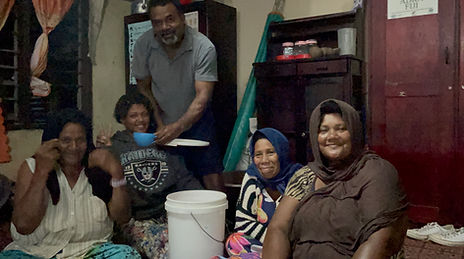
A picture of me with my host family during my volunteering project in Fiji, in the Summer of 2024.
Colonial Legacies and Intercultural Awareness
As an international student in the UK from Malaysia, a country shaped by its own colonial history under British rule, I have become increasingly aware of how colonial legacies influence everyday intercultural encounters. As I moved to the UK, I have become more critical of colonial practices, such as the assumption of Western superiority or the notion that English fluency equates to intelligence. This awareness intensified during a mental health volunteering project in Fiji in my second year, organised by Think Pacific.
Before I even joined the programme, I remember questioning what it meant for me, as a student from a previously colonised country, to participate in a volunteering project in another former British colony.
This suspicion was closely tied to my understanding of voluntourism. Conran (2011) defines voluntourism as “an activity in which people pay to volunteer in development or conservation projects.” Even in this definition, I felt a tension: the act of paying to help already suggests unequal access to mobility and “helping” itself. I also came across critiques that voluntourism can resemble neo-colonial practice (Bandyopadhyay, 2019), in which development is framed by Western presence in non-Western spaces. This made me uneasy, because I was aware that even my presence might be read through that same lens.
A big part of this discomfort came from my own past experiences. Growing up in Malaysia, I often watched Western travel vlogs where creators documented their “volunteering experiences.” While some seemed well-intentioned, I often felt unsettled watching local communities being framed as passive recipients of help. As a local viewer, I sometimes felt my own culture was being simplified or “performed” for external audiences. Even when the intention was positive, it felt like what Said (1978) describes as the creation of an “us” versus “them” dynamic, where the Global South is positioned as something to be helped rather than understood as an equal.
During the interview, I was reassured that the project would work closely with local organisations and that cultural sensitivity training would be provided. At that point, I felt slightly more comfortable, and I wanted to believe that meaningful collaboration was possible. On the surface, it seemed like the programme was aware of the very issues I was worried about.
However, my lived experience in Fiji complicated this expectation.
Arrival in Fiji: Expectations vs Reality
When I arrived in the village, I quickly noticed a gap between what was promised and what was actually experienced. Although the project was framed as a mental health volunteering initiative, our preparation felt limited. Despite many of us being psychology students, we were not professionally trained to deliver mental health workshops. We were given some online cultural resources and a brief introduction to Fijian customs, but in practice, I did not feel fully prepared for the responsibility we were given.
At the time, I remember feeling conflicted. On one hand, I wanted to contribute meaningfully. On the other hand, I felt a quiet ethical discomfort: was I really in a position to “deliver” mental health awareness in a community that I had just entered?
This is where Woodward’s (2004) idea that “the politics of personal feeling cannot address the institutional reasons for injustice” became apparent for me. I felt emotionally engaged, even caring, but still questioned whether the structure itself was reinforcing inequality rather than addressing it. It made me feel satisfied, like I was doing something good, but was I actually contributing anything to the Fijians I worked with?
The “Us vs Them” Dynamic in Practice
As I spent more time in the village, I began to observe how the “us versus them” dynamic manifested in everyday interactions.
In workshop settings and daily activities, there was a consistent tendency for volunteers and Fijians to occupy separate physical and social spaces. Volunteers would often sit together in one area, while Fijian participants remained in another. This separation was not formally enforced, but it became an unspoken norm that shaped interaction. Over time, it limited opportunities for organic engagement across groups.
This division was also reflected in how volunteers interacted with one another. The volunteers frequently moved as a collective group and tended to discuss their shared experience primarily among themselves.
Much of the conversation revolved around cultural references, travel experiences, and university life in the UK, topics that were familiar to them but often inaccessible to others outside that social context. Even as an international student in the UK, I sometimes struggled to fully engage in volunteers' conversations, as many references were rooted in specifically British or middle-class experiences, making it harder for Fijian participants to relate or participate.
My own difficulties joining these conversations, despite studying in the UK, made me realise how excluded Fijian participants might feel and suggested unspoken barriers to engagement.
According to the Social Identity Theory (Tajfel & Turner, 1979), individuals naturally categorise themselves and others into in-groups and out-groups, even in the absence of explicit division. In Fiji, this categorisation was not imposed overtly but emerged through shared language, cultural familiarity, and group dynamics.

A Schematic Diagram of Social Identity Theory's Basic Principles (Barak, 2008)
My Attempt at Bridging the Us VS Them Gap
However, I was not an exception to this “us versus them” phenomenon.
In my foster home, my host grandmother treated me with a level of hospitality that made me reflect more deeply on the relationship between “a local” and “a volunteer.” I remember being given a proper bed while she slept on a mattress, and being served food while I was rarely expected to help prepare it. Instead of feeling fully integrated, I often felt like a guest being honoured rather than a participant or volunteer contributing on equal terms. This made me reflect on how hospitality itself can reproduce subtle hierarchies, even when it is expressed through care and generosity.


Side-to-side comparison of the mattress that my host grandmother used and the only bed available in the house that the other volunteer and I slept on every night.
Because of this discomfort, I consciously began to change my behaviour. I asked myself: how can I bridge this gap? The last thing I wanted was to be seen as a volunteer who needed to be fed or catered to; I wanted to be seen as someone who belonged.I therefore began insisting on helping with cooking and washing dishes, even when it was not expected of me. I also joined my host grandmother on her evening visits around the village, choosing to participate in everyday life rather than remain within a detached “volunteer identity.” These small actions felt important because they helped reduce the passive role I felt I had been placed into and allowed me to engage more meaningfully in daily routines.

A picture of my uncle and me. Preparing for dinner by shaving some cassava or tapioca.

Another picture of me preparing the ingredients for dinner, using a hand machine to extract coconut milk.
Over time, I noticed that integration felt more natural for me compared to some other volunteers. I think part of this came from cultural familiarity. Certain aspects of Fijian social life felt recognisable to me, such as respect for elders, expectations around hospitality, and gendered norms of modesty. Even linguistic similarities played a role. I later learned that both Malay and Fijian languages belong to the broader Austronesian language family, which created moments of connection when I recognised similar-sounding words and used Malay terms that resonated with Fijian language patterns during interactions with neighbours.

I got invited to have dinner by some of the workshop participants. This is one my Fijian friend's daughters and her friends.

My first night in Fiji was spent hanging out with my close relatives, where we spent time talking and watching the "langit", sky in English. The first word that I learnt was similar in both Fijian and Malay (my mother tongue).
Reciprocal Adaptation and Belonging
As a result, I began to feel that I had integrated relatively well into the community. My foster grandmother described me as being like her own granddaughter, and I also received a handwritten letter from my foster auntie thanking me for treating her children like siblings. These moments were deeply meaningful to me, as being recognised as part of the family reflected an important aspect of my own cultural understanding, where kinship language is often used to express closeness and belonging. I also developed inside jokes with Fijian youths, often exchanging local terms in jest. One recurring joke involved calling each other "devil," which emerged as a playful sign of our growing familiarity.
At the same time, I recognise that this sense of integration was shaped not by the absence of difference, but by how difference was negotiated. I am a Muslim woman who wears the hijab, while my host family were Christian. This initially made me more aware of boundaries between us. However, over time, these differences did not prevent closeness from forming. There was a moment where I shared a few of my hijabs with them during colder weather, and they wore them playfully, joking about “converting to Islam.” While light-hearted, this interaction reflected mutual openness, where cultural difference became something shared rather than strictly separated. On another occasion, a close Fijian friend jokingly handed me a hijab made from cow’s skin. These exchanges also showed that cultural learning was reciprocal, not one-directional.
My host grandmother and close relatives with the hijabs that I gifted them

My friend with a fake hijab made out of cow skin. In the background is the cow being skinned.
As Hall & Bucholtz (2010) explain, identity is both positional and relational; it is shaped by how we see ourselves and how others position us. Through everyday interactions, I began to feel that I was no longer only “a volunteer from the UK system,” but someone who had been partially repositioned closer to the local community through relational practice and shared experience.
The Limits of Intimacy
However, although it initially felt as though I had successfully bridged the gap created by voluntourism, I later realised that this sense of resolution was more complex than it appeared. While I attempted to address the “us versus them” divide through closeness, participation, and emotional connection, I came to understand that I was relying heavily on intimacy as a means of resolution.
Berlant (1998) argues that intimacy often produces shared narratives that feel emotionally coherent and meaningful. However, Conran (2011) warns that an emphasis on intimacy in voluntourism can obscure underlying structural inequalities by reframing systemic issues as personal experiences of connection.
This became clearer to me when I reflected on my own satisfaction during the experience. I felt emotionally fulfilled by the relationships I built, yet this feeling did not necessarily correspond to any meaningful shift in the programme's structural conditions. As Woodward (2004) suggests, “the politics of personal feeling cannot address the institutional reasons for injustice.” In this sense, my emotional closeness to the community did not resolve the broader inequalities embedded in voluntourism.
This became the central tension of my experience: I was able to form meaningful relationships and reduce the emotional distance of “us versus them,” but this did not dismantle the structural conditions that produced that divide in the first place.
As Tyler (2015) suggests, one of the challenges of global life is learning to live with difference. However, my experience suggests that tolerance and intimacy alone are not sufficient. What is required is reflexivity; the ongoing process of questioning not only how we relate to others, but also how we are positioned within global systems of inequality, knowledge, and mobility.
‘‘When sentimentality meets politics, it uses personal stories to tell of structural effects, but in so doing it risks thwarting its very attempt to perform rhetorically a scene of pain that must be soothed politically.’’
- Lauren Berlant

My foster cousin and I are visiting the orchard. Me in bare foot in an attempt at integrating with their culture.
References:
Bandyopadhyay, R. (2019). Volunteer tourism and “the white man’s burden”: Globalization of suffering, white savior complex, religion and modernity. Journal of Sustainable Tourism, 27(3), 327–343. https://doi.org/10.1080/09669582.2019.1578361
Mor Barak, M. (2008). Social Psychological Perspectives of Workforce Diversity and Inclusion in National and Global Contexts. The Handbook of Human Services Management.
Conran, M. (2011). They really love me! Intimacy in volunteer tourism. Annals of Tourism Research, 38(4), 1454–1473. https://doi.org/10.1016/j.annals.2011.03.014
Hall, K., & Mary Bucholtz. (2005). Identity and interaction: A sociocultural linguistic approach. Discourse Studies, 7(4–5), 585–614. https://doi.org/10.1177/1461445605054407
Edward W. Said. (2003). Orientalism (Reprinted with a new preface; Original work published 1978). Penguin Books
Henri Tajfel, & John C. Turner. (1979). An integrative theory of intergroup conflict. In W. G. Austin & S. Worchel (Eds.), The social psychology of intergroup relations (pp. 33–47). Brooks/Cole Publishing
Imogen Tyler. (2015). Classificatory struggles: Class, culture and inequality in neoliberal times. The Sociological Review, 63(2), 493–511. https://doi.org/10.1111/1467-954X.12228
Kath Woodward. (2004). Calculating compassion. In L. Berlant (Ed.), Compassion: The culture and politics of an emotion (pp. 59–86). Routledge